.png)
Best Cement for Home Construction in Indore — OPC vs PPC Explained (2026)

Walk into any construction material shop in Indore and ask for cement — the shopkeeper will ask you back: "OPC chahiye ya PPC?" Most homeowners answer based on whatever their contractor told them, without really knowing why.
It matters more than most people think. The wrong type used in the wrong place can lead to cracks, seepage, and weaker concrete — problems that show up silently and cost lakhs to fix later.

Here's the full picture, explained simply.
What Is OPC?
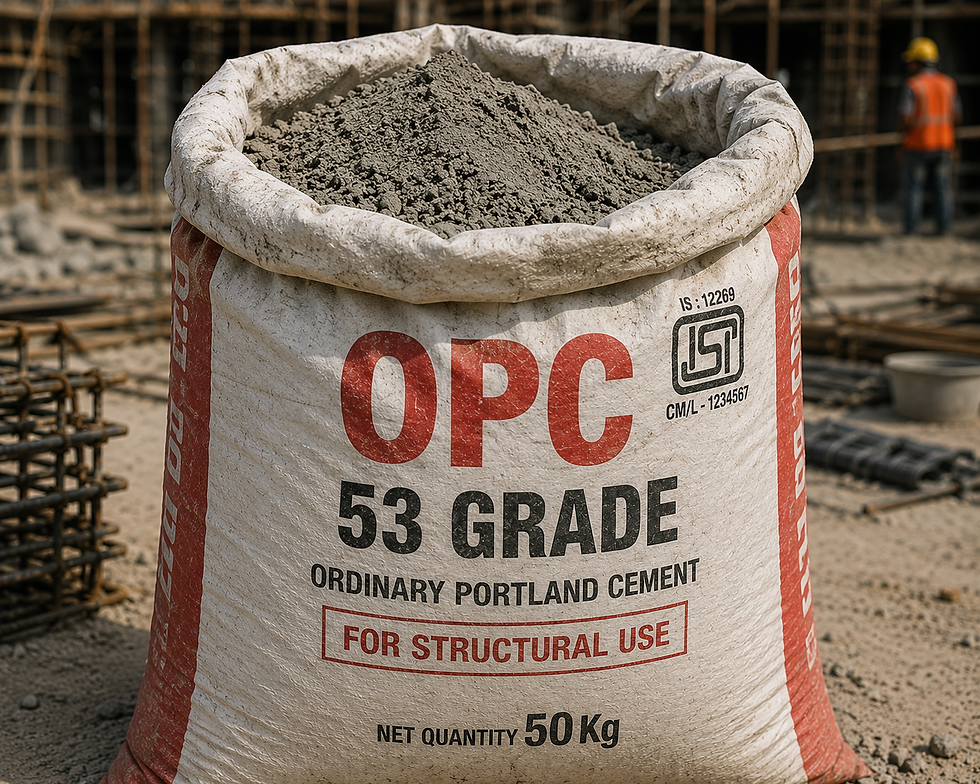
OPC stands for Ordinary Portland Cement — the oldest and most widely used cement type in India. It's made by grinding clinker with gypsum and comes in three grades:
OPC 33 — Almost obsolete. Used for basic non-structural work. Rarely found in Indore market now.
OPC 43 — Mid-strength. Used for general RCC work, slabs, and beams in standard residential buildings.
OPC 53 — Highest strength grade. Sets fast and gains strength quickly. Used for heavy structural work, columns, foundations, and commercial projects.
OPC's strength: Fast setting, high early strength. If you need concrete to gain strength quickly — precast elements, fast-cycle construction, large commercial projects — OPC 53 is the choice.
OPC's weakness: Generates high heat during setting (called heat of hydration). In Indore's peak summer (April–June when temperatures hit 40–43°C), poorly cured OPC concrete can develop thermal cracks. It needs careful water curing for at least 7–14 days.
What Is PPC?

PPC stands for Portland Pozzolana Cement. It's OPC clinker blended with pozzolanic materials — most commonly fly ash (a byproduct of thermal power plants).
There are no grades in PPC — it's a single standard. It develops strength more slowly than OPC in the first 7 days, but by 28 days it matches OPC in strength, and continues gaining strength for months after that.
PPC's strength:
Lower heat of hydration — less risk of thermal cracking in Indore's summer heat
Denser concrete matrix — better resistance to moisture and water seepage
Smoother workability — masons prefer it for plastering and masonry
Cheaper than OPC by ₹15–25 per bag in Indore's current market (2026)
Fly ash content makes it environment-friendly and IMC-compliant (fly ash bricks and blended cements are officially encouraged in MP)
PPC's weakness: Slower early strength gain. Not ideal when you need concrete to carry loads quickly.
OPC vs PPC — What to Use Where in Your Indore Home

This is the practical guide most people actually need:
Use OPC for:
Columns and footings (where early high strength matters)
Precast elements like compound wall posts or lintels
Any work where the contractor needs to strip formwork quickly to stay on schedule
Commercial buildings with heavy structural loads
Use PPC for:
Brickwork and block masonry
Internal and external plastering
Floor screeding and tile bedding
Water tanks, sump pits, and any area with constant water contact
Terrace slab top surface (PPC's low permeability resists monsoon seepage better)
General RCC slabs where early strength is not critical
What most experienced contractors in Indore actually do: OPC for structural concrete (columns, beams, foundations). PPC for everything else. This is the right approach — and what you should confirm your contractor is following.
Indore's Climate Makes PPC the Smarter Default for Most Work

Indore sits in a semi-arid climate with extreme summer heat and a 4-month monsoon. Both conditions push in favour of PPC for most residential applications:
Summer (March–June): Temperatures regularly cross 40°C. OPC's high heat of hydration adds to thermal stress in fresh concrete. PPC generates significantly less heat during setting — reducing the risk of thermal cracking in slabs and walls.
Monsoon (June–September): High humidity and driving rain test the permeability of any concrete surface. PPC's denser concrete matrix and fly ash content make it naturally more resistant to water penetration — critical for terraces, external walls, and basement floors.
For a standard residential home in Indore — duplex, G+1, or G+2 — PPC handles 70–80% of the cement requirements across the project. OPC is used selectively for structural concrete.
Cement Brands in Indore — What's Available and What to Prefer

All major national brands are available through dealers in Indore's material markets (Navlakha, Rajwada area, and various locality-based dealers). As of May 2026:
UltraTech Cement — India's largest brand. Widely available in Indore. Consistent quality across batches. PPC priced around ₹370–400 per 50 kg bag. OPC at ₹390–420. First choice for most Indore contractors for structural work.
ACC Cement — Decades of trust, strong in Central India. PPC around ₹370–400. Good availability in Indore through established dealer networks. ACC Gold Water Shield PPC variant is popular for monsoon-prone projects.
Ambuja Cement — Known for moisture resistance. PPC priced around ₹360–390 per bag. Particularly good for plastering and masonry in Indore's humid monsoon months.
Shree Cement / Dalmia — Good quality at slightly lower prices (₹340–370 range). Worth considering for large projects where budget matters and brand loyalty is flexible.
JK Lakshmi / Birla Super — Regional brands with reasonable availability in MP. Solid mid-range options.
Practical tip: In Indore, consistent supply from a nearby dealer matters as much as brand. A project that runs out of cement mid-slab because a premium brand isn't available locally causes more damage than using a slightly less premium brand that's always in stock. Discuss brand availability with your contractor before specifying in the agreement.
How Much Cement Will Your Indore Home Need?
A rough estimate to help with budgeting:
For a 1,000 sq ft built-up area (foundation + walls + slab): approximately 400–450 bags of cement (50 kg each).
For a 1,500 sq ft duplex: approximately 600–700 bags across both floors
Cement consumption varies with concrete mix design, wall thickness, number of floors, and finishing quality
At current Indore market prices (₹370–420 per bag for major brands), cement cost for a standard 1,000 sq ft home ranges from approximately ₹1.5 lakh to ₹1.9 lakh. For a full duplex, budget ₹2.5–3 lakh for cement alone.
This is why the 18% GST rate on cement that came into effect in 2025 (reduced from the old 28%) has made a meaningful difference to construction budgets — approximately ₹30,000–50,000 savings on cement cost for a standard Indore residential project.
One Thing Many Homeowners Skip — Check the Manufacturing Date

Cement has a shelf life. It starts absorbing moisture from the air the moment the bag is opened — or even through a slightly damaged bag. Cement older than 3 months loses measurable strength, and older than 6 months should not be used for structural work.
Before accepting any cement delivery on your construction site:
Check the manufacturing date printed on the bag
Reject bags older than 3 months for structural use
Check bags for hardness — lumps inside mean the cement has already started absorbing moisture and should be rejected
Store cement on raised wooden platforms, not directly on the ground, and away from walls
This is a basic quality check that costs nothing but prevents significant structural risk.
The Simple Rule for Your Indore Home

OPC for columns, beams, and footings. PPC for everything else.
From a trusted brand — UltraTech, ACC, or Ambuja are the safest choices in Indore's market in 2026. Shree and Dalmia are good value alternatives. Specify the brand and type in your construction agreement — not just "good quality cement."
Shriketu Construction Pvt. Ltd. follows this approach on every residential project in Indore — right cement type for the right structural element, sourced from verified dealers, with manufacturing date checks at delivery. If you want to build with material accountability built into the process from day one, their team is worth talking to before you start.
Quick Reference
OPC | PPC | |
Strength gain | Fast (high early strength) | Slower early, stronger long-term |
Best use | Columns, beams, foundations | Masonry, plaster, slabs, water contact areas |
Heat of hydration | High (risk in Indore summer) | Low (safer in hot climate) |
Moisture resistance | Moderate | High (denser matrix) |
Price (Indore, 2026) | ₹390–420/bag | ₹360–400/bag |
Shelf life | 3 months from manufacture | 3 months from manufacture |
Availability in Indore | Excellent | Excellent |


Comments