.png)
Curing Concrete — Why Watering Your Slab for 28 Days Actually Matters


After your slab is cast, most contractors pour water on it for 3–4 days and move on. Some skip it almost entirely. You've probably seen it happen on sites across Indore.
This is one of the most common and most damaging shortcuts in Indian residential construction. And the damage it causes doesn't show up immediately — it shows up years later as cracks, weak concrete, and seepage that costs lakhs to fix.
Here's what curing actually is, why 28 days is the number, and what Indore's climate does to uncured concrete.
What Is Curing?

When concrete is poured, cement doesn't just "dry." It undergoes a chemical reaction called hydration — cement particles react with water to form a hard crystalline structure. This is what gives concrete its strength.
Curing is simply the process of keeping concrete wet long enough for this reaction to complete properly.
If concrete dries out too fast — from heat, wind, or sun — the hydration reaction stops prematurely. The result is concrete that looks solid but never reached its designed strength.
Why 28 Days?
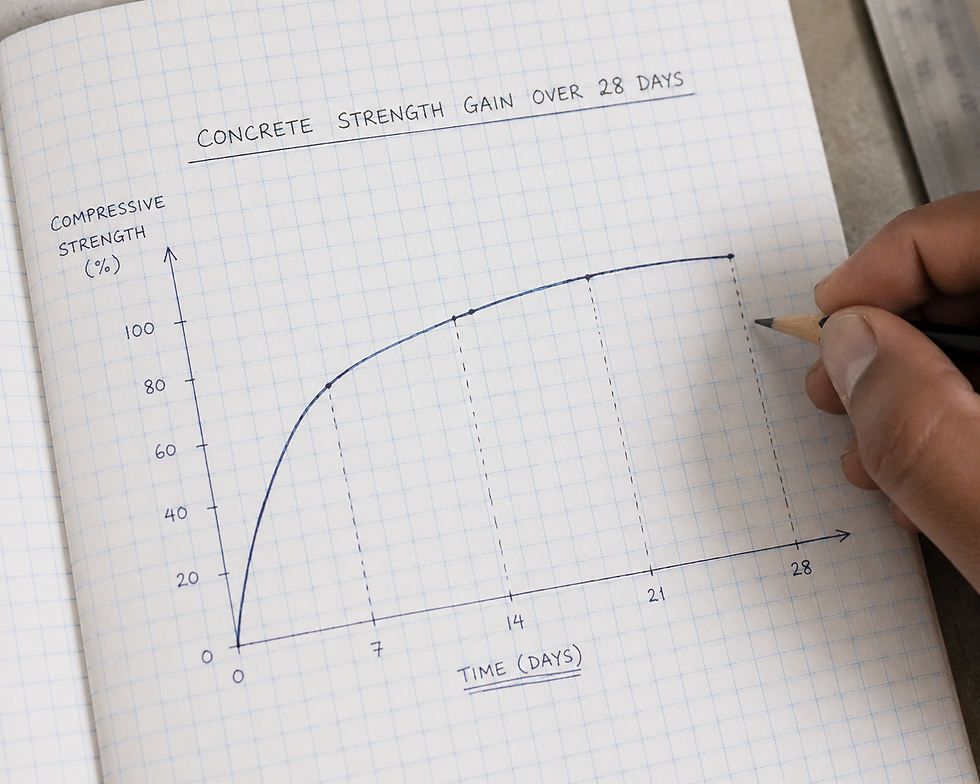
Concrete gains strength in stages:
24–48 hours — hard enough for foot traffic
7 days — reaches roughly 70% of design strength
28 days — reaches 99% of its full design strength as per IS:456, India's standard code for RCC construction
The first 7 days are the most critical. If concrete loses moisture during this window, strength development is permanently compromised — no amount of watering later fully reverses it.
After 28 days, hydration is essentially complete. Curing beyond this point gives diminishing returns.
What Indore's Climate Does to Uncured Concrete

Indore has one of the harshest environments for fresh concrete in Central India:
Summer (March–June): Temperatures of 40–43°C combined with dry winds cause concrete to lose surface moisture within minutes of pouring. This rapid evaporation causes plastic shrinkage cracks — fine cracks that form on the surface before concrete even sets. Once formed, these cracks become permanent pathways for water ingress during the monsoon.
Monsoon (June–September): The humidity helps curing naturally — but rain hitting fresh concrete within the first few hours can wash away surface cement, weakening the top layer. Protection from direct rain in the first 24 hours matters as much as keeping it wet after.
Winter (November–February): Cold temperatures slow the hydration reaction. Concrete cast in Indore's mild winters actually benefits from slightly longer curing periods.
The bottom line: in Indore's peak summer months, uncured concrete loses moisture so fast that even a few missed watering cycles in the first week causes measurable strength loss.
Curing Methods — What Works Where

Ponding — Building small mud or brick borders around the slab and filling with water. Most effective for flat surfaces like roof slabs and floors. Keeps concrete continuously wet with minimal effort. Best method for Indore's summer.
Wet Gunny Bags / Hessian Cloth — Covering concrete surfaces with jute bags or cloth and keeping them wet. Good for columns, beams, and vertical surfaces where ponding isn't possible. Needs to be re-wetted 3–4 times a day in Indore's summer.
Curing Compounds — A liquid chemical sprayed on fresh concrete that forms a membrane, trapping moisture inside. Increasingly used for large commercial slabs. Convenient but requires the right product and correct application timing. Not a substitute for water curing in standard residential construction.
Plastic Sheeting — Covering concrete with polythene sheet traps evaporating moisture. Simple and effective for slabs when labour for continuous watering isn't available. Must be sealed at edges to work.
What Happens When Curing Is Skipped or Done Poorly

The consequences are invisible at first — which is exactly why contractors get away with it:
Reduced compressive strength. Concrete cured for only 3 days achieves roughly 50–60% of its potential strength. You've paid for M20 concrete (design strength of 20 N/mm²) and got something closer to M10 in practice — without knowing it.
Surface cracking. Plastic shrinkage cracks form within hours on uncured slabs in Indore's summer. These hairline cracks are the entry points for monsoon water into the slab, eventually rusting the embedded TMT steel.
Rebar corrosion. Water entering through cracks reaches the steel reinforcement. Steel corrodes, expands, and causes concrete to spall — chunks breaking away from columns and slabs. This type of structural damage is expensive and sometimes irreparable without major reconstruction.
Dust and weak surface. An uncured slab surface dusts when rubbed — the top layer is essentially powdery, weak concrete. This affects flooring adhesion, tile fixing, and waterproofing performance.
The Right Curing Process for an Indore Home

For a standard residential slab in Indore, here's what should happen:
Day 0 (casting day): Protect fresh concrete from direct sun and wind immediately after finishing. Cover with wet gunny bags or curing compound within 2–4 hours of pouring.
Days 1–7: Water continuously — ponding on slabs, wet cloth on columns. In peak summer, watering 4–5 times a day. This is the critical window. Do not allow the surface to dry out even once during this period.
Days 8–28: Continue watering at least twice daily. Reduce frequency gradually after day 14 but don't stop completely.
Formwork removal: Column and beam formwork should not be removed before 7 days minimum. Slab props (centering) should remain for 14–21 days depending on span and load.
How to Check if Your Contractor Is Curing Properly
You don't need to be on site 24 hours. A few practical checks:
Morning visit: The slab surface should feel cool and wet to the touch, not warm and dry. A warm dry slab in summer means it dried out overnight — curing has lapsed.
Check the gunny bags: They should be wet and dark in colour. Dry, light-coloured bags mean they haven't been watered.
Look at columns: Wet patches running down columns indicate active curing. Dry, chalky column surfaces don't.
Ask for a watering schedule in writing. A contractor who takes curing seriously will have a site worker assigned to it and won't hesitate to confirm this.
Build Strong From the Inside Out
A well-cured slab and well-cured columns are invisible once your home is finished. But they determine how your building performs for the next 50 years — under load, under Indore's monsoon, and in the unlikely event of an earthquake.
Shriketu Construction Pvt. Ltd. follows IS:456 curing standards on every project in Indore — proper ponding on slabs, wet cloth on vertical elements, and formwork removal only after the minimum period is met. If you want construction quality that goes beyond what's visible on the surface, their team is worth talking to.
Quick Reference
Stage | What Should Happen |
Immediately after pour | Cover with wet gunny bags or curing compound within 2–4 hours |
Days 1–7 | Continuous moisture — most critical window, no dry periods |
Days 8–28 | Twice daily watering minimum |
Column formwork removal | Not before 7 days |
Slab props (centering) removal | Not before 14–21 days |
Concrete at 7 days | ~70% of design strength |
Concrete at 28 days | ~99% of design strength (IS:456) |
The rule: Concrete that looks hard is not necessarily cured. Strength comes from chemistry, not appearance. Water it — properly, for the full period.


Comments