.png)
How Many Floors Can You Build on Your Plot in Indore? — FAR & Coverage Explained

Navigating real estate regulations doesn't have to feel like decoding a legal textbook. If you are planning to construct a home or a multi-unit asset in Indore, understanding the precise limits of what you can build is step one. The key to maximizing your property’s potential while staying completely compliant lies in three core metrics: Floor Area Ratio (FAR), Ground Coverage, and Marginal Open Spaces (MOS).
Here is the top-down breakdown of exactly what you need to know.
1. The Core Metric: FAR (Floor Space Index)

FAR dictates the total usable floor area you are legally permitted to build relative to your plot size.
The Formula: FAR = Total Built-up Area (all floors combined) ÷ Total Plot Area.
The Indore Standard: Under the MP Bhumi Vikas Niyam, the base FAR for standard residential plots in Indore is typically 1.25.
What it means: If you own a 1,000 sq. ft. plot, a 1.25 FAR means you can build a maximum of 1,250 sq. ft. of enclosed space across all floors. Note that elements like open balconies, standard staircases, and parking are usually exempted from this calculation.
2. Ground Coverage: Your Building Footprint

While FAR controls the total volume, Ground Coverage controls the footprint. You cannot simply cover the entire plot with concrete from edge to edge.
The Limit: Permissible ground coverage usually ranges from 33% to 60%, heavily depending on your plot's exact dimensions and road width. For an average residential plot, expect to cap out around 50%.
The Rule: If you have a 1,000 sq. ft. plot with a 50% coverage limit, your ground floor footprint cannot exceed 500 sq. ft.
3. Setbacks / Marginal Open Spaces (MOS)

To ensure proper ventilation, fire safety, and neighborhood planning, local regulations enforce Marginal Open Spaces (MOS). These are the mandatory gaps between your building and the plot boundary.
Front MOS: Usually a minimum of 3 meters (approx. 10 feet).
Rear & Side MOS: Typically 1.5 meters (approx. 4.5 feet), scaling up based on the plot size.
The Catch: These areas must remain open to the sky. Encroaching on MOS is a strict violation. Unlike minor internal changes, you cannot usually "compound" or pay a penalty to legalize structures built over the mandatory front open space.
4. The Verdict: How Many Floors Can You Actually Build?

Let’s combine FAR, Coverage, and MOS into a practical answer.
For a standard residential plot in Indore, you are generally restricted to G+2 (Ground Floor + 2 Upper Floors).
If you max out your ground coverage at 50%, you consume 0.50 of your FAR on the ground floor.
Building the exact same size on the first floor consumes another 0.50 (Total: 1.00 FAR).
You are left with 0.25 FAR for the second floor—effectively allowing for a half-floor or a smaller penthouse setup.
Note: The municipal system (ABPAS) will not pass a plan exceeding these metrics. While premium FSI or compounding fees can sometimes buy you roughly 10% extra space, G+2 remains the hard structural limit for standard independent plots to prevent density overload.
Maximizing Your Property’s Value
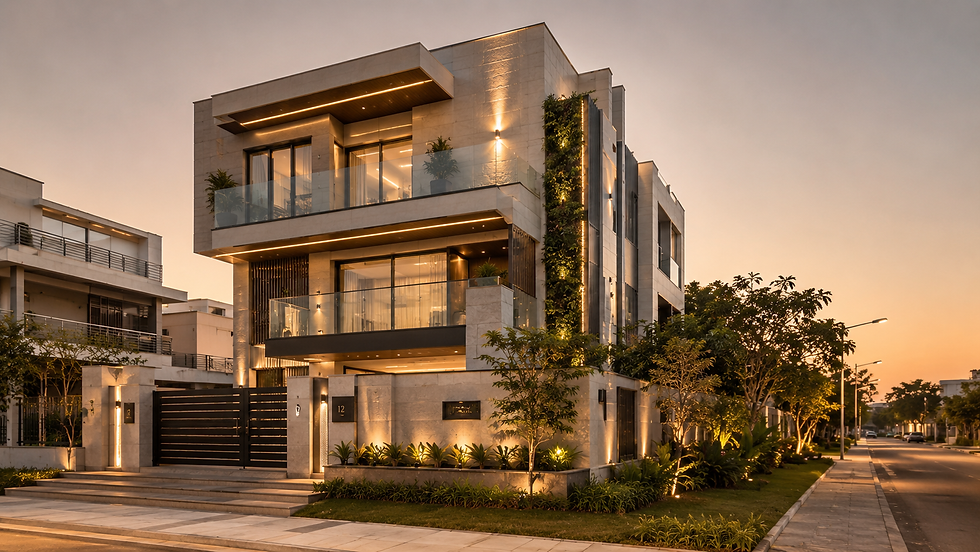
Building a property is about creating a high-leverage asset. Instead of seeing these rules as restrictions, use them as a design framework. A well-planned G+2 structure with a premium, minimalist aesthetic, clever use of natural light through the mandatory open spaces, and a highly optimized floor plan will always yield a much higher market value than an over-constructed building that risks municipal penalties.


Comments