.png)
RCC vs Steel Frame Construction — Which is Better for Indore's Climate?
- ammar quadri
- May 16
- 7 min read

If you've started researching how to build a home or commercial property in Indore, you've probably come across both options — RCC (Reinforced Cement Concrete) construction and steel frame construction. And if you've asked more than one contractor, you've likely gotten different answers from each of them.
The honest answer is: both are valid structural systems. But they are not interchangeable, and the right choice depends heavily on your project type, budget, and importantly — how the structure will actually perform in Indore's specific climate over the long run.
This is a breakdown of both systems, how they compare on the factors that actually matter for Indore, and where each one makes sense.
What Are We Actually Comparing?

Before getting into Indore's climate specifically, it helps to understand what each system actually is.
RCC Construction RCC stands for Reinforced Cement Concrete. It's the most widely used structural system in India for residential and small-to-mid commercial buildings. Columns, beams, and slabs are cast in concrete with steel reinforcement bars (TMT bars) running through them. The concrete handles compression, the embedded steel handles tension — together they create a structure that's strong under vertical loads and reasonably resilient if designed well.
Most homes in Indore you see around you — G+1, G+2, G+3 independent houses — are RCC construction. So are most low-to-mid-rise apartment buildings and standalone commercial shops.
Steel Frame Construction Steel frame construction uses prefabricated structural steel sections — columns, beams, and trusses — as the primary load-bearing skeleton of the building. The steel framework is fabricated off-site in a controlled environment and assembled on-site. Walls, floors, and cladding are then added around this skeleton.
Steel frame is the dominant structural system for large commercial buildings, industrial warehouses, IT parks, malls, and increasingly, mid-to-large commercial projects in growing Tier-2 cities like Indore.
Indore's Climate — What Your Structure Has to Deal With
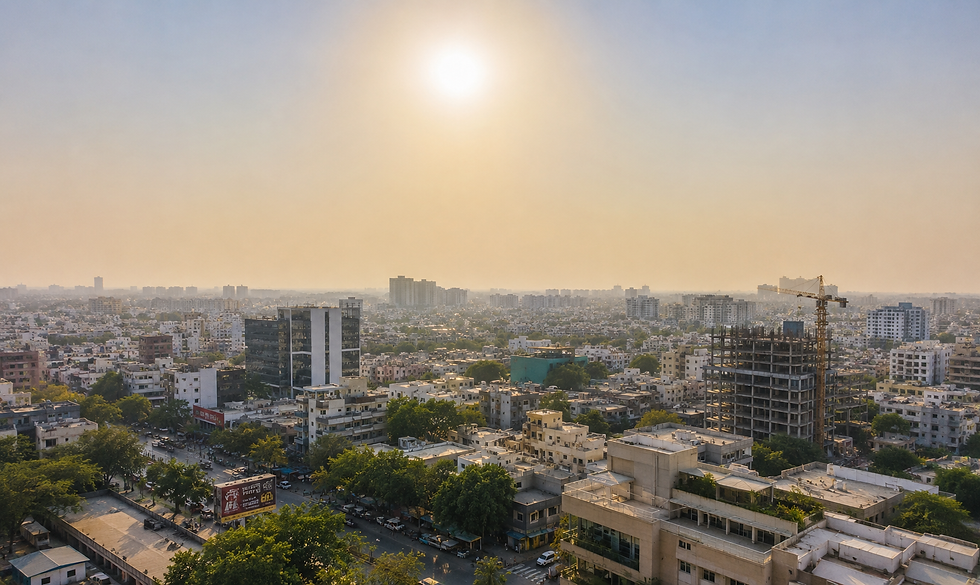
Here's the part most comparison articles skip. Indore has a specific climate that directly affects how these two structural systems perform over time.
Extreme Summer Heat Indore summers run from mid-March to mid-June with temperatures regularly hitting 40–43°C. This is critical for one key reason: steel conducts heat. An exposed or inadequately insulated steel frame structure can heat up significantly during peak summer, making interiors uncomfortably warm without robust HVAC systems or proper thermal insulation.
RCC, on the other hand, has high thermal mass. Concrete absorbs heat during the day and releases it slowly at night, which naturally moderates indoor temperature fluctuations. In Indore's climate, this is a genuine comfort advantage — especially for residential buildings where air conditioning usage directly adds to running costs.
Monsoon Humidity Indore receives its monsoon from mid-June to mid-September, and humidity peaks at around 85–90% in August. Sustained high humidity is steel's most significant long-term enemy. Without proper anti-corrosion coatings and maintenance, steel members can corrode over time in humid conditions. Quality steel frame construction today uses factory-applied anti-corrosion treatments and galvanised connections, which significantly reduce this risk — but it does require attention to specification and maintenance in a way RCC does not.
RCC is not immune to moisture either — unprotected rebar inside poorly designed or poorly executed concrete can corrode if water ingress occurs. But when correctly executed, RCC requires less ongoing moisture-related maintenance than steel.
Seismic Zone III — This Matters More Than Most People Think The entire Indore district falls within Seismic Zone III as per the Bureau of Indian Standards classification — which means the region is vulnerable to earthquakes of up to 6.5 on the Richter scale. This is a moderate-to-high seismic risk category for Central India.
This is where steel frame construction has a clear structural advantage. Steel's ductility — its ability to bend without breaking — allows steel frame buildings to absorb and dissipate seismic energy far more effectively than rigid concrete. RCC structures can be designed for seismic resistance, but it requires careful engineering, proper detailing of joints, and strict quality control during casting. A poorly executed RCC structure in a seismic zone is significantly more dangerous than a well-designed one.
Black Cotton Soil Indore and much of the Malwa plateau is characterised by black cotton soil — a expansive soil type that swells with water and shrinks when dry. This means foundations need to go deep enough to reach stable soil below the expansive zone. Both RCC and steel frame buildings need appropriate foundation design for this soil type, but the foundation requirements are the same regardless of which structural system is used above ground.
Cost — Where Things Stand in 2026

RCC Construction Cost in Indore For residential construction, RCC in Indore currently runs between ₹1,700 and ₹2,500 per sq ft depending on quality. The structural RCC work alone — columns, beams, slabs — accounts for roughly ₹800–1,000 per sq ft of that figure. Materials (cement, steel TMT bars, aggregates) make up 60–65% of the total project cost.
Steel Frame Construction Cost Steel frame construction typically costs 20–38% more upfront than an equivalent RCC structure for the same building design and load conditions. For commercial buildings in Indore, steel frame projects are generally quoted in the ₹2,800–₹5,000+ per sq ft range depending on complexity, finishes, and systems included.
However, the upfront cost comparison is only part of the picture. Steel frame construction is significantly faster — a steel-framed structure can be erected in 30–50% less time than an equivalent RCC structure, since there is no waiting for concrete to cure (which takes 21–28 days per slab in RCC). For commercial projects, this time savings translates into earlier occupancy and revenue, which partially offsets the higher initial material cost.
For residential construction in Indore — independent houses, duplexes, G+2 and G+3 buildings — RCC is almost always the more economical choice upfront and over the first 15–20 years of the building's life.
Which is Better — A Practical Breakdown

For Indore Homes (Independent Houses, Duplexes, G+1 to G+3) RCC is the practical choice. It is cost-effective, widely understood by local contractors, uses materials that are abundantly available in Indore, provides natural thermal comfort in the summer heat, and when designed properly for Seismic Zone III, performs reliably. The vast majority of quality residential construction in Indore is RCC, and for good reason.
For Commercial Buildings (Offices, Showrooms, Retail) Mid-to-large commercial projects increasingly make sense as steel frame, especially when open floor plans, large column-free spans, or tight construction timelines are priorities. Steel gives design flexibility that RCC cannot easily match — longer spans without intermediate columns, which is particularly valuable for showrooms, warehouses, or office spaces where floor layouts need to be flexible.
For Industrial and Warehouse Projects Steel frame is the default choice, and has been for years. The combination of large clear spans, faster construction, and expandability makes it far more suitable than RCC for these applications.
For Multi-Storey Residential Apartments RCC remains dominant in the mid-rise apartment segment in Indore. Most apartment buildings up to 10–12 floors are RCC. Steel starts to become more competitive above that height range, or in projects where speed is a premium consideration.
Maintenance and Longevity in Indore's Climate
A properly executed RCC structure in Indore, with good waterproofing and concrete quality, can last 50–75 years with routine maintenance. The common issues — hairline cracks, seepage, spalling concrete — are mostly consequences of poor workmanship during construction, not inherent failures of the system.
A steel frame structure with proper anti-corrosion coating and maintenance can last 75–100 years. The key phrase is "with proper maintenance." In Indore's monsoonal humidity, steel connections, joints, and any exposed sections need periodic inspection and recoating. This is manageable with the right contractor but is a longer-term commitment that many homeowners underestimate.

The Verdict for Indore
There is no universal winner — but there is a clear answer for most projects.
If you are building a home in Indore, RCC construction is the right choice in 2026. It is cost-effective, climatically appropriate, thermally comfortable through Indore's brutal summers, widely available in terms of skilled labour, and well-understood by local engineers and contractors. Designed correctly for Seismic Zone III and executed with proper concrete mix and TMT steel, it will serve a family reliably for generations.
If you are building a commercial property — especially anything with large open spans, tight deadlines, or multi-floor office or retail space — steel frame construction deserves serious consideration alongside RCC. The higher upfront cost is often recoverable through faster construction and the design freedom it provides.
In either case, the quality of execution matters far more than the choice between the two systems. A well-built RCC structure will outperform a poorly executed steel frame one every time — and vice versa. The structural system is only as good as the engineering behind it and the workmanship on site.
Why Your Choice of Contractor Matters as Much as Your Choice of Material

The debate between RCC and steel frame construction is often settled not at the design stage, but during execution. In Indore, RCC quality varies enormously between contractors. The concrete mix design, TMT bar grade and placement, curing time, and column-beam joint detailing all determine whether a structure actually achieves its designed strength and seismic resistance — or just looks like it does.
This is exactly why working with an experienced, technically sound construction company matters. Shriketu Construction Pvt. Ltd. handles both residential RCC projects and larger structural builds across Indore, with a track record of executing construction to specification — including seismic design compliance and proper material sourcing. If you're in the planning stage and trying to decide which structural system fits your project, their team can walk you through a realistic assessment based on your plot, budget, and intended use — before you commit to anything.

Quick Reference — RCC vs Steel Frame for Indore
Cost: RCC is lower upfront. Steel is 20–38% higher upfront but faster to build.
Thermal performance in Indore's summers: RCC is better. Concrete's thermal mass moderates indoor temperatures naturally.
Monsoon/humidity resistance: RCC requires less maintenance. Steel needs proper anti-corrosion treatment and periodic inspection.
Seismic Zone III performance: Steel frame has a structural advantage due to ductility. RCC can perform comparably if designed and executed correctly.
Best for homes: RCC
Best for large commercial/industrial: Steel frame
Construction speed: Steel is 30–50% faster.
Labour availability in Indore: RCC contractors are far more widely available. Skilled steel frame erection teams are fewer.
Long-term lifespan: Both can last 50–100 years with appropriate maintenance and quality execution.


Comments